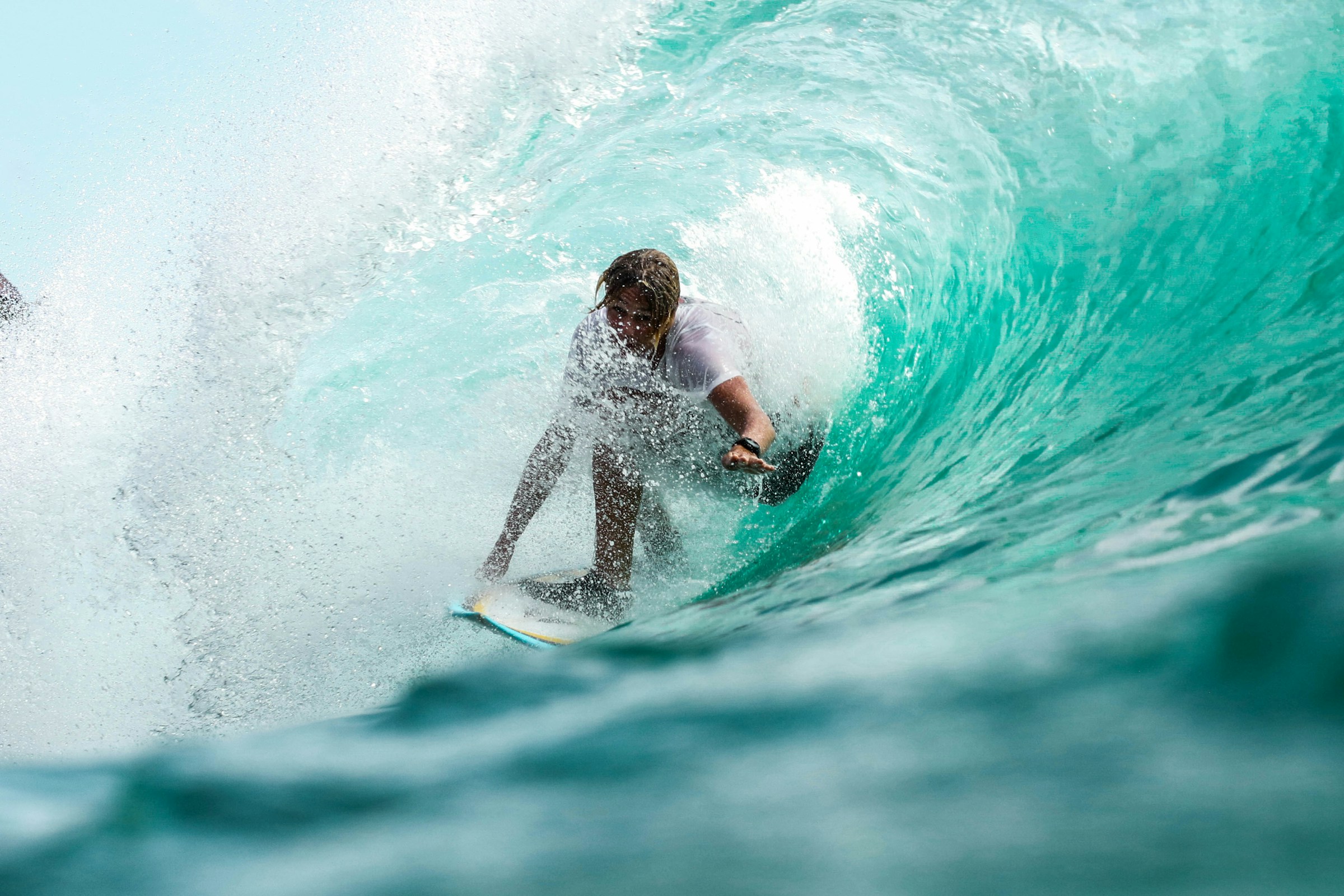

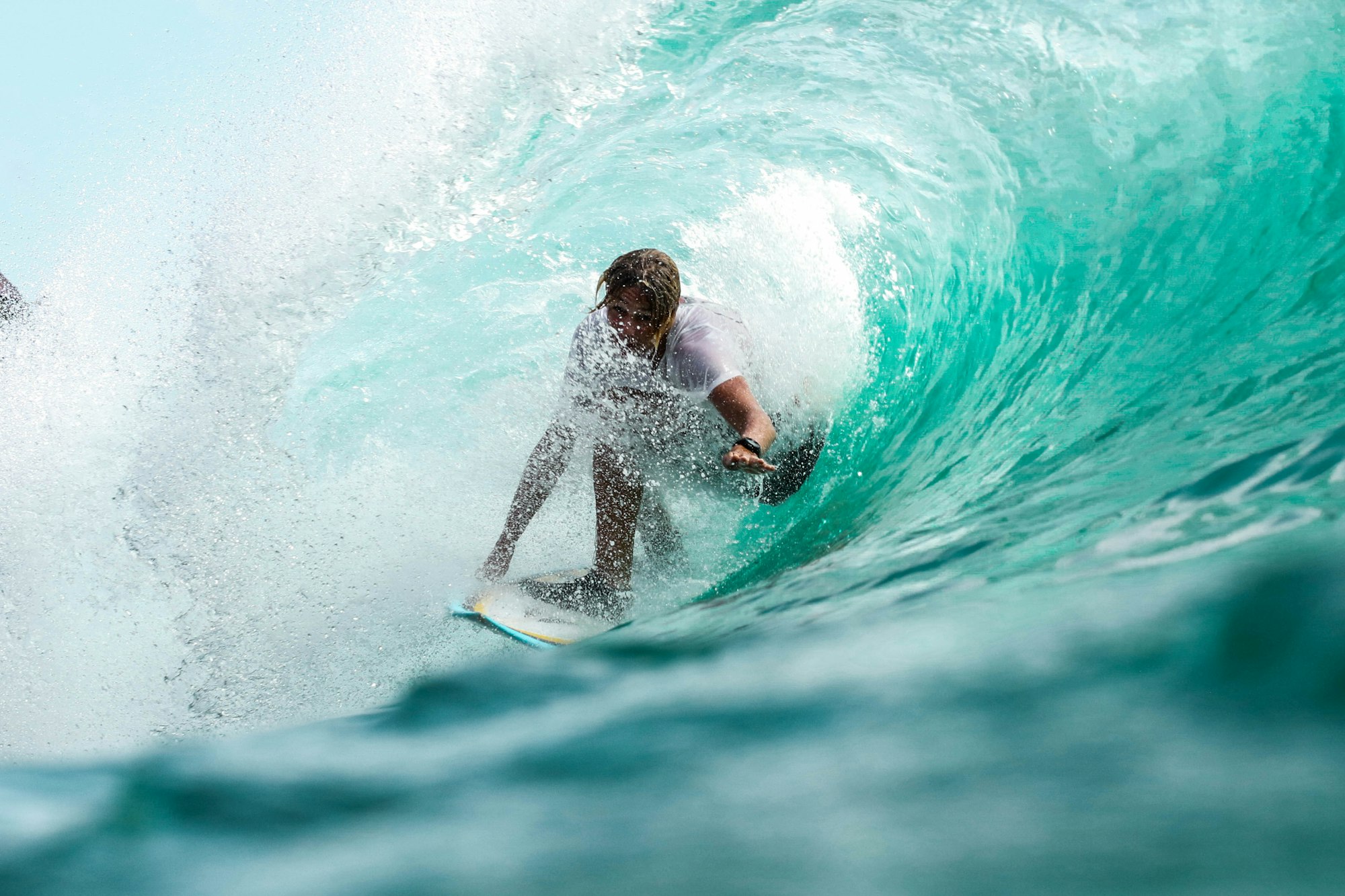
There is a photograph taken in the winter of 1992 that shows a seventeen-year-old Kelly Slater inside a Pipeline barrel so deep that the only light visible is a white disc at the end of a long green tunnel. The wave is maybe twelve feet on the face. His body is a single line — arm trailing, back foot dug in — and the expression, what you can see of it through the spray, is not concentration exactly. It is closer to recognition. As if he had been here before, in some room inside himself, and the ocean had simply agreed to build it around him.
Thirty-five years later, I watch him paddle out at the same break on a December morning when the North Shore is doing what the North Shore does: building sets out of nowhere, holding them for a long, flat moment, and then releasing them all at once in a way that makes the beach go quiet. He is fifty-two. He is wearing a plain black wetsuit. Nobody except the photographers seems to notice he has arrived.
I. The shape of an obsession
Pipeline is not the most dangerous wave in the world, though it has killed more surfers than any other. What makes it singular is its precision. The reef beneath it — a shallow shelf of lava twelve feet below the surface at low tide — forces every wave to break in almost exactly the same place, with almost exactly the same shape, at almost exactly the same speed. It is predictable in the way that a guillotine is predictable. You know what is going to happen. The question is only whether you have read it correctly.
Slater has surfed Pipeline more times than he can count and says he still does not fully understand it. "It changes every winter," he tells me, sitting on the sand at Ehukai after a two-hour session. "The sand moves. The reef shifts. You think you know it and then it shows you something new." He is not complaining. He is describing the appeal.
You think you know it and then it shows you something new. That's the whole thing, isn't it. Kelly Slater
Eleven world titles. The first at twenty, the last at thirty-nine. A career that has outlasted three generations of competitors, two different formats of professional surfing, and the patience of everyone who has spent the last decade predicting his retirement. He has not retired. He has, instead, returned to Pipeline for what he calls "one more proper season" — a phrase he has used, by my count, four times in the last six years.
II. North Shore, December
The house he rents sits a block from the water in Sunset Beach, a modest place with a lanai facing the mountains and a garage full of boards that he has shaped himself. There are no trophies visible. There is a stack of books on the kitchen counter — a biography of Nikola Tesla, a novel by Colm Tóibín, a worn copy of something by Krishnamurti — and a half-eaten mango on the cutting board.
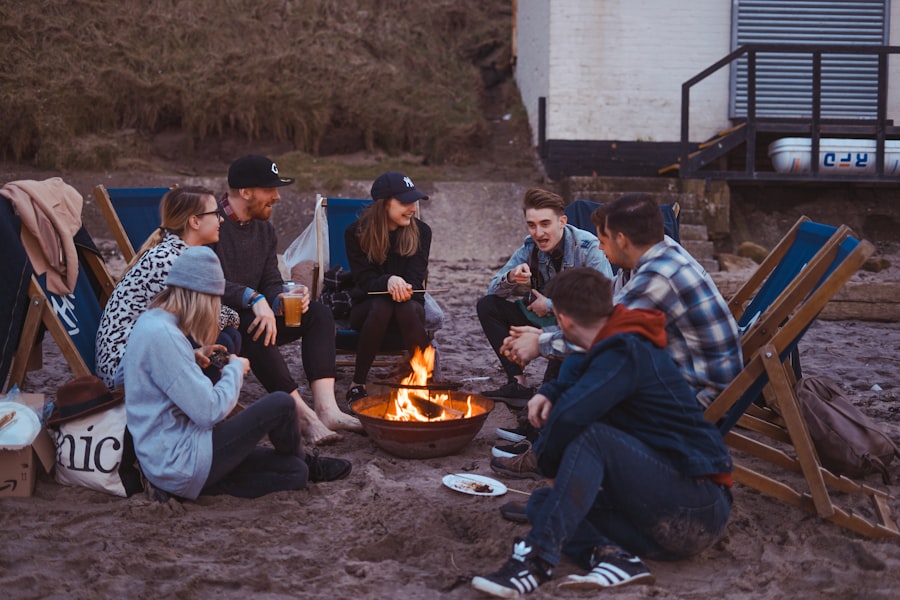
He talks about the wave the way a composer might talk about a particular chord — not as a problem to be solved but as something with its own interior life, its own logic that you spend years learning to hear. "When it's good," he says, "there's a moment right at the ledge where time slows down. You either make it or you don't, but for a second you're completely in it. Nothing else exists."
III. What remains
I ask him what a perfect wave would feel like, if he got one this season. He is quiet for a moment. Out on the water, a set arrives — six waves, well-spaced, each one a little bigger than the last. We both watch it without speaking.
"I don't think about perfect," he says, finally. "Perfect is a photograph. What I want is the one that surprises me. The one that asks something I haven't been asked before." He pauses. "I don't know if that happens at fifty-two. But I'd like to find out."
He stands, brushes sand from his wetsuit, and picks up the board he shaped himself — a 7'2" gun with a single red pin line running rail to rail. The next set is already visible on the horizon, a dark line thickening against the pale sky. He walks toward it without looking back, the way people walk toward things they have been moving toward their entire lives.
Read the full story
This piece is available to Surfed subscribers. Join to read every essay, dispatch, and 12 years of archive — without ads.
Cancel anytime · No ads · Full archive
Comments 9
The image of her asking for decaf at 7am after two hours in the water — that's the whole portrait right there. You don't need the eight titles once you have that detail.
Thank you, Maren. The decaf detail did more work than any statistic could — I'm glad it landed the same way for you.
I grew up surfing Snapper in the early 2000s. There was always something different about the way she moved on a wave — a patience most of us never find at any age. This piece captures exactly that.
Same era for me. That stretch of sand produced more world titles per square meter than anywhere on earth — and somehow she made it look unhurried.